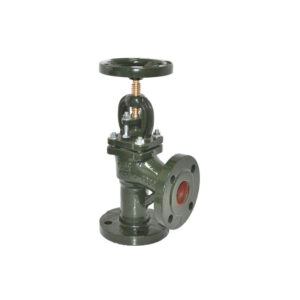
What is a globe valve?
A globe valve is a linear motion valve used to start, stop and regulate a fluid. The disc of the globe valve can be fully opened or closed. During the opening and closing of the globe valve, the disc moves perpendicular to the seat.
This movement creates the annular space between the disc and the seat ring which gradually closes as the valve closes. This feature provides the globe valve with good fluid control capability.
Diagram of the globe valve
In the drawing of the globe valve shown below, we can see how the valve works. The picture also shows the direction of flow in and out of the valve.

Globe valves can be installed so that the disc closes against the flow or in the direction of flow.
When the disc closes in the direction of flow, the kinetic energy of the fluid assists in closing but obstructs the opening. This feature is suitable when fast-acting closing is required.
When the disc closes against the direction of flow, the kinetic energy of the fluid obstructs closing but assists in opening the valve. This feature is preferable when fast-acting opening is required.
PARTS OF A GLOBE VALVE
In the picture you can see the parts of the globe valve, such as body, bonnet, plug, seat, packing, etc.

TYPES OF GLOBE VALVES
Depending on the body type we have three types of globe valves:
Z Type, Y Type, Angular Type.

GLOBE VALVE TYPE Z
The simplest and most common design is the Z-body. In this type of Z-type configuration the globe body itself contains the seal seat. The horizontal seating arrangement allows the shaft and sealing disc to move perpendicular to the pipe axis, which results in a very high pressure drop.
The valve seat is easily accessible through the bonnet, which has a large opening in the upper part of the valve body. The stem passes through the bonnet as in a gate valve. This design simplifies manufacturing and repair. This type of valve is used where load drop is not a concern and where regulation is required.

GLOBE VALVE TYPE Y
The Y-type design is a solution to the problem of head loss in Z-type valves. In this type of construction, the seat and shaft are at an angle of approximately 45° to the axis of the pipeline. Y-body valves are used in high pressure applications and other critical services where pressure drop is a problem.

ANGLE TYPE GLOBE VALVE
The angle globe valve rotates the flow direction by 90 degrees without the use of an elbow and additional pipe welding. This type of globe valve can also be used in fluctuating flow conditions. They are widely used in the naval sector to save space.
GLOBE VALVE TYPES BASED ON BODY CAP CONNECTION
THREADED COVER: This is the simplest design available and is used for economical valves.
SCREWED LID: This is the most common design and is used on a large number of globe valves. This type requires a gasket to seal the joint between the body and bonnet.
WELDED LID: This is a design used when disassembly is not necessary. It is lighter and prevents leakage through the lid.
PRESSURE SEAL: This type is commonly used for high pressure and high temperature applications. The higher the body cavity pressure, the greater the force on the seal in a pressure seal valve.
Globe valves are used in systems where fluid regulation is required and where leak tightness is also important.
It is used in high point vents and low point blowdowns where leak tightness and safety are important concerns.
It can be used on steam, chemicals, air, lube oil and almost all services where pressure drop is not a problem.
This valve is also used as an automatic control valve, but in that case, the valve stem is a smooth rather than a threaded shaft and is opened and closed by the action of an actuator.
ADVANTAGES of the Globe Valve
- Good closure, reliable
- Suitable for frequent use, low seat and disc wear.
- Easy to repair, as the seat and disc can be accessed from the top of the valve.
- The operation is faster compared to the gate valve due to a shorter stroke length.
- Operated by automatic actuator, it becomes an excellent regulator.
DISADVANTAGES of the Globe valve
- Obstructions and discontinuities in the flow path cause high pressure drop.
- In a large high-pressure line, pulsations and shocks can damage internal parts.
- Large valves require considerable power to open and generate noise while in operation.
- They are heavier than other valves of the same pressure rating.
- More expensive compared to the gate valve.
BALLOON WITH BELLOWS
Bellows-seated globe valves have become one of the most widely used types in recent years.
Reductions in maintenance schedules in industry have had a lot to do with the success of these valves.
BELLOWS VALVE
It is a variant of the globe valve that has a bellows to protect the outside of the valve from stem leakage.
This type of valve has become the king of thermofluid and steam installations due to its safety against external leakage and its price/performance ratio compared to the conventional packing type.
There are seat valves of the CLOSING-RETENTION type, these incorporate a check valve in the valve itself and therefore act as such with the valve open and closed like a conventional seat valve.
The use of these valves is only for the naval sector where space is at a premium, saving the installation of 2 valves.
Angle valves, with or without a retension, are also widely used in the shipbuilding industry in order to reduce installation distances by eliminating the need to install a pipe elbow.